DIFFERENTIAL GROWTH / FAÇADE STUDY
A façade that blooms.
Thirty fins. Fixed at the back. Free to fold at the front.
01 / HOLD
Keep the rear edge fixed.
The full-height attachment line stays in place. The fin begins as a nearly flat, 3.2 m deep surface perpendicular to the building.
02 / GROW
Add length at the free edge.
Growth increases toward the front of each fin. Stronger and quieter zones extend across the façade instead of repeating the same shape.
03 / RELAX
Let folds find their shape.
The solver balances stretch, bending and contact between fins. Changing the controls generates a new solution in your browser.
GROW YOUR OWN DESIGN
Give the method to your agent.
Download the Agent Skill to create a façade with your own fin count, dimensions, spacing and growth pattern. It includes the C++ solver and a local runner that exports an OBJ, the parameters and geometry checks.
How to use it
Unzip the download and give the grow-blooming-facade folder to your coding agent. Ask it to read SKILL.md, then describe your design. The included runner requires Python 3 and a C++17 compiler.
Use this Skill to grow a façade with 18 fins, 8 m high and 2.4 m deep, spaced 1.4 m apart. Keep the rear edges fixed, use uneven growth up to 220%, and export the OBJ with its parameters and geometry checks.
Rectangular fin studies work through the included controls. Curved supports, imported meshes and different attachments require the agent to adapt the source and checks. This is a form-finding tool; structural and fabrication performance are not evaluated.
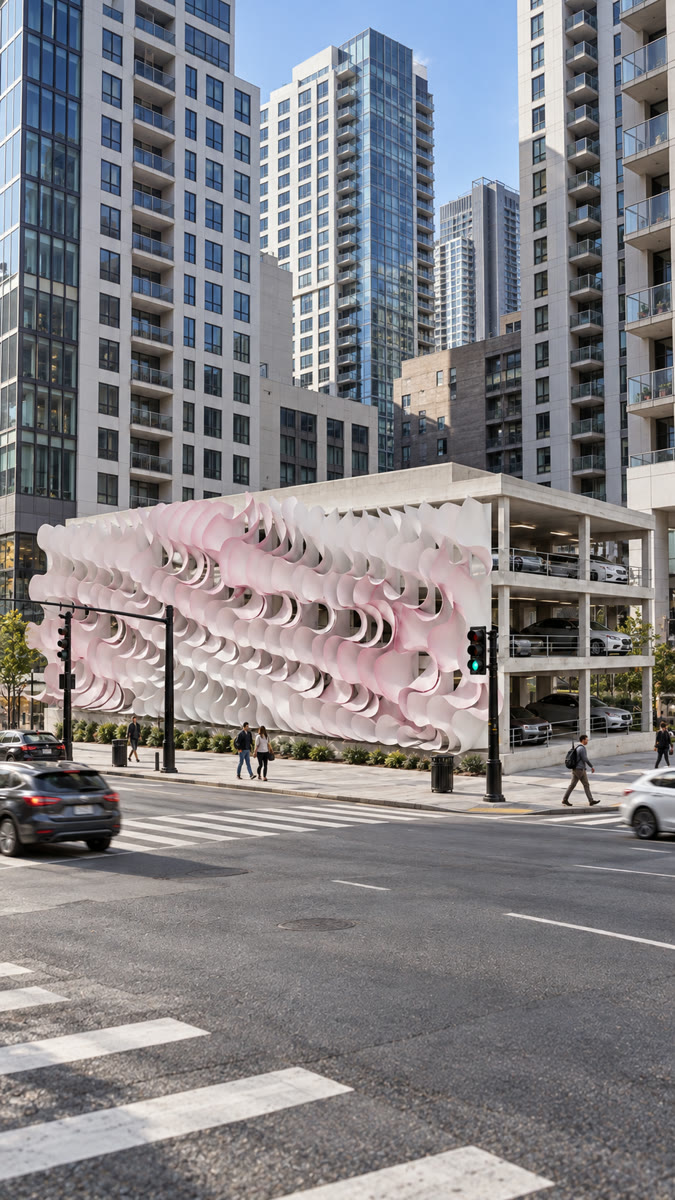
FROM GROWTH TO ARCHITECTURE
A different face for a parking garage.
The 3D model is the computational study. This image imagines the façade in a dense city setting.
The solver checks contact and limits unsafe steps. New parameter combinations need their own geometry checks. This is a form-finding study, with no thickness, structural design or fabrication validation.
Solver documentation ↗